"for those around the turn of the century who were seriously committed to the potentials of photography as a creative art, the fundamental stumbling block seemed to be the medium's uncompromising specifity. if not allowed to follow it's natural bent, the camera described not Man, but men, not Nature but countless precise biological and geological facts. this tendency was not in harmony with the artistic spirt of the time, which preferred and idealized view, and which sometimes confused vagueness with poetry.'
i was unsuccessful on finding the accompanying image online, but this is it:
alvin langdon coburn
[untitled] no date
plate 3 from the cloud (1912)
4.29.2008

4.18.2008
charlie the unicorn 2
OH MY GOD. this is so much more ridiculous than the first. i don't think this would be completely great to watch while on drugs. craaazy.
i'm posting the first one again.

4.10.2008
trick or treating
i've been meaning to post this since we were given our narrative assignment and my inability to sleep right now allowed me to remember.
this is the first video i ever did- back in september '06 for my media arts class. we had to create a story (aka, narrative) in under a minute (which was challenging- i started out near two minutes and really had to cut down on the number and length of clips). i started my bad habit of not using tripods basically ever in this video (and it's horribly apparent; i've gotten a better at hiding it). and while making this i realized that yeah yeah yeahs' songs can be used in near any video (and i do use them quite often). if i went back and redid this, i'd change a few things and think i could do it a bit better, but mostly i was and still am quite satisfied with it.
my absolute favorite part is when she puts on the hanable lector (major way off spelling) mask and the lyrics are "lost my scene again." my not sure why i like it so darn much, but it just seems to go so well with the video and i think that's a great part where the visual and audio mesh perfectly together.
trick or treating
this is the first video i ever did- back in september '06 for my media arts class. we had to create a story (aka, narrative) in under a minute (which was challenging- i started out near two minutes and really had to cut down on the number and length of clips). i started my bad habit of not using tripods basically ever in this video (and it's horribly apparent; i've gotten a better at hiding it). and while making this i realized that yeah yeah yeahs' songs can be used in near any video (and i do use them quite often). if i went back and redid this, i'd change a few things and think i could do it a bit better, but mostly i was and still am quite satisfied with it.
my absolute favorite part is when she puts on the hanable lector (major way off spelling) mask and the lyrics are "lost my scene again." my not sure why i like it so darn much, but it just seems to go so well with the video and i think that's a great part where the visual and audio mesh perfectly together.
trick or treating
#22 out of 22 (maya deren)!
so i finally caught back up with the posts. woo! but i still haven't posted my flip book yet... i should get on that. oh well. and maybe my first post doesn't count cause basically i was just like "i'm not used to getting up early yet."
a few random things first:
1. herr's cheddar & sour cream chips are the shit.
2. orange juice is also the shit, but these two do not mix well.
3. insomnia sucks- especially when you have an 8:30 class.
4. writing class is a waste of time at the college level.
5. my "i" key fell off my laptop and won't go back on- this makes typing difficult.
okay, well. the basic things about maya deren:
the oddities i found interesting:
as always- thanks to wikipedia.
at land (1944)
i like the frantic/ crazed/ desperate/ confused nature of the beach part during the last 5min. a lot. more than the other sections. although her expression at the very first section's pretty sweet... and i don't know much what else to say. i'm kinda bad at interpreting stuff.
a few random things first:
1. herr's cheddar & sour cream chips are the shit.
2. orange juice is also the shit, but these two do not mix well.
3. insomnia sucks- especially when you have an 8:30 class.
4. writing class is a waste of time at the college level.
5. my "i" key fell off my laptop and won't go back on- this makes typing difficult.
okay, well. the basic things about maya deren:
- born eleanora duse on april 29th, 1917 in kiev, ukraine
- died october 13, 1961 new york city, usa
- became a naturalized citizen of the usa at age 11
- began college at syracuse university, finished at new york university; started master's n english literature at the new school for social research, completed it at smith college
- awarded a guggenheim fellowship for "creative work in the field of motion pictures" in 1946
- first and most well known film is meshes of the afternoon (1943)- with alexander hammid, music added in 1957 by teij ito
- at land (1944), photographed by hella heyman and alexander hammid
- a study in choregraphy (1945), choreographed collaboration with frank westbrook and rita christiani, featuring anaïs nin and gore vidal
- the private life of a cat (1947), co directed by alexander hammid- boooooringgg
- meditation on violence (1948), performance by chao-li chi, musical collage by maya deren
- the very eye of night )1952-55), with metropolitan opera ballet school and antony tudor, music by teiji ito
- four unfinished films, one unreleased film
- worked with 16mm film
the oddities i found interesting:
- married gregory bardacke at age 18 (married 1935- 1939)
- married to alexandr hackenschmied (aka, alexander hammid) from 1942- ????
- married to teiji ito from late 50s- death (who was 18 years younger than her and later married someone 12 years younger than himself)
- became a personal secretary after earning master's
- practiced voodoo
- claimed to make her pictures "for what hollywood spends on lipstick"
- died from a brain hemorrhage due to extreme malnutrition and 20ish years of amphetamihes (adderall and the like) and sleeping pills, which she was taking on a daily basis when she died
as always- thanks to wikipedia.
at land (1944)
i like the frantic/ crazed/ desperate/ confused nature of the beach part during the last 5min. a lot. more than the other sections. although her expression at the very first section's pretty sweet... and i don't know much what else to say. i'm kinda bad at interpreting stuff.
new narrative idea
i changed how i'd be presenting my narrative pretty much right after i posted about it. i'm going to either take out or reshoot the sections where the setting noticeably bounces around. i shot about 50 clips so far with the same story. i'm splittng them up for about 1/3 a second shown, 1/2 second missing, 1/3 shown, 1/2 sec missing. so it looks a little like images, but it's video.
i might change the lengths. i'm not sure about transitions. i'll probably change the order. i wasn't sure how long to leave the single still image shown for- that's why it's still at 5 seconds. and a whole bunch of other stuff that indicates this is an EXTREMELY rough draft of any idea.
i might change the lengths. i'm not sure about transitions. i'll probably change the order. i wasn't sure how long to leave the single still image shown for- that's why it's still at 5 seconds. and a whole bunch of other stuff that indicates this is an EXTREMELY rough draft of any idea.
and it goes on to say...
obviously the definition of avant garde has changed over the years.
"Each successive modernist movement of the 19th century-- Realism, Impressionism, and Post-Impressionism-- challenged artistic conventions with greater intensity. This relentless challenge gave rise to the avant-garde. Use of this term has expanded over the years; t now serves as a synonym for any particularly new or cutting-edge cultural manifestation. [Avant-garde] derived from the 19th-century French military usage... It then migrated to the art world in the 1880s, where it referred to artists who were ahead of their time and who transgressed the limits of established art forms... The avant-garde were modernists n that they rejected the classical, academic, or traditional and they adopted a critical stance toward their respective media. Yet they departed from modernism n their art's extreme transgressiveness or subversiveness." (Gardner's Art Through the Ages: Twelfth Edition, pg 886)
anyone in my class probably knows that though because they are also required to take art history.
"Each successive modernist movement of the 19th century-- Realism, Impressionism, and Post-Impressionism-- challenged artistic conventions with greater intensity. This relentless challenge gave rise to the avant-garde. Use of this term has expanded over the years; t now serves as a synonym for any particularly new or cutting-edge cultural manifestation. [Avant-garde] derived from the 19th-century French military usage... It then migrated to the art world in the 1880s, where it referred to artists who were ahead of their time and who transgressed the limits of established art forms... The avant-garde were modernists n that they rejected the classical, academic, or traditional and they adopted a critical stance toward their respective media. Yet they departed from modernism n their art's extreme transgressiveness or subversiveness." (Gardner's Art Through the Ages: Twelfth Edition, pg 886)
anyone in my class probably knows that though because they are also required to take art history.
4.03.2008
internet in furness sucks ballz.
art history got me thinking about a few things. we're up to 19th century-ish in that class.
my reading today brought up avant garde very very briefly. for those of you who don't know, avant garde is the pushing of cultural norms, most commonly within art. so what made me go hum, was that orginally, vincent van gough's work was once considered avant garde. i never would have guessed cause his work seems... peaceful almost, i think. i knew he wasn't appreciated during his time, but... van gough- avant garde? anyone one else a little shocked by that?
our teacher mentioned today that early photography wasn't accepted as REAL art. real art took time and skill- photography didn't. i think photography back then had to be much more difficult than it is now. they didn't have little dials on their camera telling them what the best aperture would be based on the light. they weren't able to take pictures at 1/1000 of a second. early early photography must have been so challenging.
this is kind of how i feel about digital photography (for the very very most part). i think there's too many people who use a digital camera and know how to do nothing in a dark room and call themselves a photographer. with digital it's so easy to just set it to automatic and not have to do ANY work besides pushing a button. i suppose this is true for taking 35mm pictures too (my camera only has manual settings, so i've never done this and forget about it). someone in my high school photo class carried a digital camera around all the time and took pictures of every single and random object imaginable (i assume her logic behind this is that if you have 3,000 photographs a few are bound to be good). what really ticked me off though was that she took a picture with a digital picture, sent off somewhere online for it to be printed, had our teacher matt it for her, and got a gold star in scholastics for it. she's majoring in photography and never bothered learning to do things properly in a dark room.
i'm not bashing digital completely. i get it; i believe it can aid photography. i just think people use it as a crutch too much. and it makes me sad that it's replacing traditional photography.
i was going to mention henri cartier bresson here cause for some reason i thought he was taking pictures in the early 1900s (making him one of the early photographers). buuut. this isn't true cause he was born in 1908, haha. i'll mention him anyways cause he's super cool. he used 50mm film for a majority of his pictures and was one of the first street photographers. one of my high school teachers told me that he never used any filters or dodging and burning, that he only printed "perfect" photographs (i dunno if this is true, haha. that teacher said quite a few things that weren't unfortunatly).

my reading today brought up avant garde very very briefly. for those of you who don't know, avant garde is the pushing of cultural norms, most commonly within art. so what made me go hum, was that orginally, vincent van gough's work was once considered avant garde. i never would have guessed cause his work seems... peaceful almost, i think. i knew he wasn't appreciated during his time, but... van gough- avant garde? anyone one else a little shocked by that?
our teacher mentioned today that early photography wasn't accepted as REAL art. real art took time and skill- photography didn't. i think photography back then had to be much more difficult than it is now. they didn't have little dials on their camera telling them what the best aperture would be based on the light. they weren't able to take pictures at 1/1000 of a second. early early photography must have been so challenging.
this is kind of how i feel about digital photography (for the very very most part). i think there's too many people who use a digital camera and know how to do nothing in a dark room and call themselves a photographer. with digital it's so easy to just set it to automatic and not have to do ANY work besides pushing a button. i suppose this is true for taking 35mm pictures too (my camera only has manual settings, so i've never done this and forget about it). someone in my high school photo class carried a digital camera around all the time and took pictures of every single and random object imaginable (i assume her logic behind this is that if you have 3,000 photographs a few are bound to be good). what really ticked me off though was that she took a picture with a digital picture, sent off somewhere online for it to be printed, had our teacher matt it for her, and got a gold star in scholastics for it. she's majoring in photography and never bothered learning to do things properly in a dark room.
i'm not bashing digital completely. i get it; i believe it can aid photography. i just think people use it as a crutch too much. and it makes me sad that it's replacing traditional photography.
i was going to mention henri cartier bresson here cause for some reason i thought he was taking pictures in the early 1900s (making him one of the early photographers). buuut. this isn't true cause he was born in 1908, haha. i'll mention him anyways cause he's super cool. he used 50mm film for a majority of his pictures and was one of the first street photographers. one of my high school teachers told me that he never used any filters or dodging and burning, that he only printed "perfect" photographs (i dunno if this is true, haha. that teacher said quite a few things that weren't unfortunatly).
4.02.2008
the virgin suicides
[beware, i'm going to be critical- something completely new and unheard of for me]
let's begin wayyy back at the beginning:
over christmas break, my stepmom gave me a book to read, the ruins (i can't recall who it's by). she's a big horror fan and reads A LOT of books, but this was the first she actually recommended to me. a few weeks ago, i took it to etching in case i had some down time. this chick in my class asked if it was good, but of course i hadn't started to read it yet. well, i heard it was going to be made into a movie and i mentioned this to that girl today. annnd. her response was that the only books made into movies she liked were tankgirl (although it had been a comic book), children of men, and the virgin suicides. and we had a little discussion about that, so i figured the basis of that'd be a good topic for here (where i have trouble coming up with things to talk about.
i've seen children of men and the virgin suicides, but i haven't read either of them.
children of men i liked, a lot. but. the ending? apparently it was supposed to be left that wide open and make you wonder. i don't think it was a good place to stop. i was totally shocked when it did, i must have missed the whole climax of the movie. that movie made me realize what it was like to feel like you'd wasted hours of your life that you'd never get back. the second half of the movie exxxed out anything meaningful that had happened earlier. i was hoping for more. i think there could have been more.
i'd heard sooo much about the virgin suicides before i saw it and kirsten dunst was in it, so i was kind of excited to see it. buuut... i don't think any part of it was interesting. it seemed like a whole bunch of random, pointless moments strung together. a moral can easily be guessed at, but it's not really stated (clearly or un clearly). from what i've read about the book online, it seems to be written in a pretty interesting way: a group of men who had lived in the neighborhood during the time of the events regained fascination and searched for evidence and clues as to what had happened to the family.
but, yeah. maybe someday i'll read the books if i ever get enough motivation.
let's begin wayyy back at the beginning:
over christmas break, my stepmom gave me a book to read, the ruins (i can't recall who it's by). she's a big horror fan and reads A LOT of books, but this was the first she actually recommended to me. a few weeks ago, i took it to etching in case i had some down time. this chick in my class asked if it was good, but of course i hadn't started to read it yet. well, i heard it was going to be made into a movie and i mentioned this to that girl today. annnd. her response was that the only books made into movies she liked were tankgirl (although it had been a comic book), children of men, and the virgin suicides. and we had a little discussion about that, so i figured the basis of that'd be a good topic for here (where i have trouble coming up with things to talk about.
i've seen children of men and the virgin suicides, but i haven't read either of them.
children of men i liked, a lot. but. the ending? apparently it was supposed to be left that wide open and make you wonder. i don't think it was a good place to stop. i was totally shocked when it did, i must have missed the whole climax of the movie. that movie made me realize what it was like to feel like you'd wasted hours of your life that you'd never get back. the second half of the movie exxxed out anything meaningful that had happened earlier. i was hoping for more. i think there could have been more.
i'd heard sooo much about the virgin suicides before i saw it and kirsten dunst was in it, so i was kind of excited to see it. buuut... i don't think any part of it was interesting. it seemed like a whole bunch of random, pointless moments strung together. a moral can easily be guessed at, but it's not really stated (clearly or un clearly). from what i've read about the book online, it seems to be written in a pretty interesting way: a group of men who had lived in the neighborhood during the time of the events regained fascination and searched for evidence and clues as to what had happened to the family.
but, yeah. maybe someday i'll read the books if i ever get enough motivation.
3.31.2008
cindy sherman
okay, background info:
- born january 19, 1954 in glen ridge, new jersey
- originally went to buffalo state college studying painting
- gave up painting for photo cause of painting's "limitations"
- failed a required photo class the first time around
- supposedly not her work isn't feminist, yet many call attention to the stereotyping of women in films, television and magazines
- received the macarthur award in 1995
- named on of the top ten living artists by artnews magazine in 1999
series:
- untitled film stills (1975- 1980)
- gleams and reflections (1980)
- centerfolds (1981)
- fashion (1983- 1984)
- fairy tale disasters (1985- 1989)
- history portraits (1985- 1989)
- civil war (1991)
- mannequins (1992)
- the office killer (1996, film)
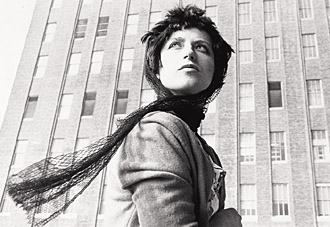
"Untitled Film Still #58"
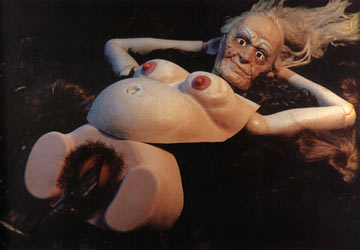
"Untitled #250"
okay, so this is totally my opinion (duh), but i think the first image is a whole lot better and interesting. i think that her "sex pictures" are completely tasteless. the fairy tale series (which i had trouble finding decent pictures of online) are creepy in an interesting way. i don't think i've seen any of the history, civil war, or gleams and reflections pictures. but by far, i like the untitled film series most.
- born january 19, 1954 in glen ridge, new jersey
- originally went to buffalo state college studying painting
- gave up painting for photo cause of painting's "limitations"
- failed a required photo class the first time around
- supposedly not her work isn't feminist, yet many call attention to the stereotyping of women in films, television and magazines
- received the macarthur award in 1995
- named on of the top ten living artists by artnews magazine in 1999
series:
- untitled film stills (1975- 1980)
- gleams and reflections (1980)
- centerfolds (1981)
- fashion (1983- 1984)
- fairy tale disasters (1985- 1989)
- history portraits (1985- 1989)
- civil war (1991)
- mannequins (1992)
- the office killer (1996, film)
okay, so this is totally my opinion (duh), but i think the first image is a whole lot better and interesting. i think that her "sex pictures" are completely tasteless. the fairy tale series (which i had trouble finding decent pictures of online) are creepy in an interesting way. i don't think i've seen any of the history, civil war, or gleams and reflections pictures. but by far, i like the untitled film series most.
Subscribe to:
Posts (Atom)
